 RaveMaker
Overview
A quick reference for scheduling tasks on Linux using cron, covering crontab syntax, practical examples, environment variables, and output logging.
General Information
To edit the Cron Table use: crontab -e
To view the Cron Table use: crontab -l
The crontab file
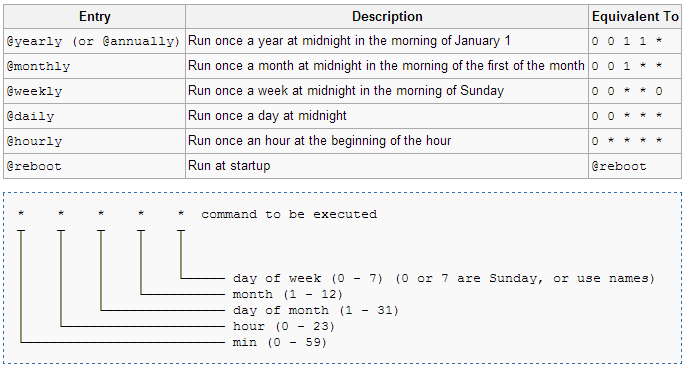
| Minute | Hour | Day of Month | Month | Day of Week | Command |
|---|---|---|---|---|---|
| (0-59) | (0-23) | (1-31) | (1-12 or Jan-Dec) | (0-6 or Sun-Sat) |
Using Cron Examples
Run ‘check.sh’ script every 3 Minutes : \*/3 \* \* \* \* /scripts/check.sh
Run ‘check.sh’ script every Day at 07:00 : 0 7 \* \* \* /scripts/check.sh
Run ‘check.sh’ script every 24th of the Month at 13:10 : 10 13 24 \* \* /scripts/check.sh
Run ‘check.sh’ script every Sunday at 21:53 : 53 21 \* \* 0 /scripts/check.sh
Additional Info
Adding Environment Variables : Cron doesn’t export any of the profile files, so if you need a path variable you can set it in crontab (using crontab -e) : PATH=$PATH:/sbin:/bin/usr/local/bin:/usr/local/sbin:/scripts 0 \* \* \* \* root /scripts/check.sh
Output your command to a log file : 0 \* \* \* \* /sbin/ping -c 10.0.0.1 >> /scripts/cron.log
Run as a different user (for example root) : 0 \* \* \* \* root /scripts/check.sh